Partner with Econify to strategically use full stack, AI, mobile, OTT, and cloud engineering to solve complex challenges
Challenge
Criteria for Success built Collavia, a sales enablement platform, with a team that had no engineers on it. They worked in browser windows, prompting ChatGPT and Claude.ai and moving the output into place by hand. The approach took them further than it had any right to. The people who understood the sales problem were the ones shaping the product, and they had working software while a conventional build would still have been in discovery.
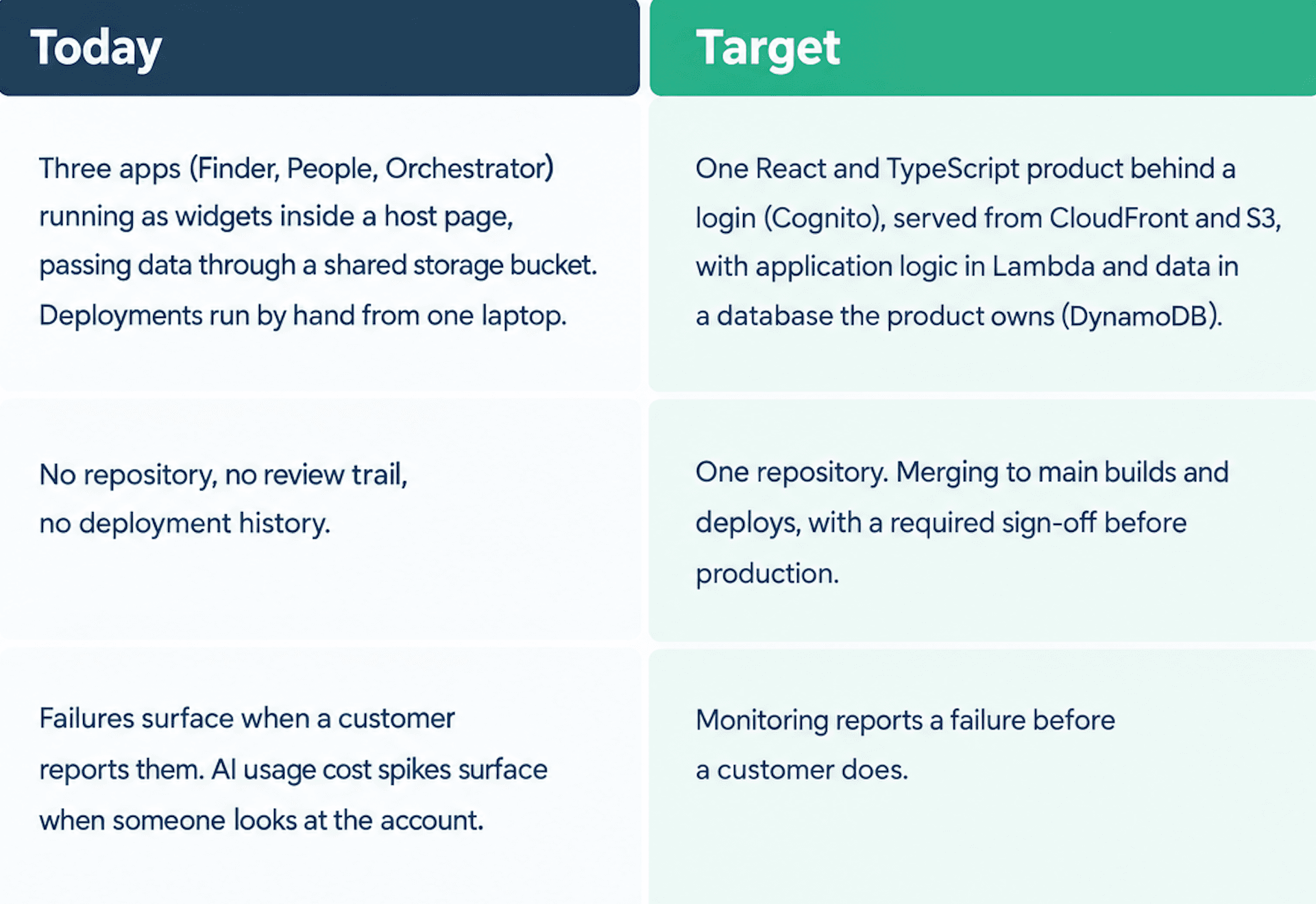
What existed at the end of it was three separate applications, sharing data through a storage bucket and running only when embedded inside another system. Releasing a change meant one person running a command from one laptop. There was no repository, no review trail, and no way to trace how a decision had been made or roll back a step that broke something.
That’s a commercial constraint before it’s a technical one. A product assembled that way demos well. Staffing it, selling it, or handing a piece of it to someone new all assume there’s a codebase to hand over.
Goals
Give the existing code a stable home with a review trail and a history
Take deployment off a single laptop
Teach the team to work in the codebase with Claude Code rather than around it
Decide whether three applications should stay three applications
Two days of Claude Code training, a codebase moved into version control, and a rearchitecture scoped off the back of both.
What we found
This pattern is becoming common; the prompting was doing its job but the medium was wrong and the wrong driver was behind the wheel. Collavia existed and people were using it. The gap sat in the infrastructure around the tooling: source control, environments, a deployment path that didn’t depend on one machine, and a data store the product actually owned.
Timing is part of the diagnosis. Teams notice the gap at the point where the software has become valuable enough that nobody wants to touch it, which is also the point where changing it costs the most. Criteria for Success was close to that line. Before training would be worth running, the code needed a stable home.
Solution
One of our engineers moved everything the team had built into GitHub. Single repository, clean commit history, a branch-and-review workflow. That turned a collection of prompt output into a project other people could join.
Our team then delivered two days of training against the Collavia codebase rather than a sample project. Day one covered Claude Code fundamentals, model selection, data stores, version control, and the cloud services the team would deploy against. Day two moved to prompt best practices, context management, tests, skills, plugins, and the workflow to carry forward.
The throughline was the set of decisions that quietly cost money or create risk later. Which model to reach for, given that defaulting to the largest one on every task is an expensive habit to form early. How to keep context tight enough that the tool stays accurate as the codebase grows. When to commit, and why the honest answer is more often than feels necessary.
Where the architecture goes next
Training gave the team a way to work. The next engagement addressed consolidating the three applications into one product in React and TypeScript and backed by a Dynamo data store, ported incrementally and deployed to AWS.