Be the first to know when registration opens for the next Inside AI with Econify session.
Inside AI
Inside AI with Econify: Is There a Winner in the AI Development “Horse Race”?
Mon, Apr 13, 2026
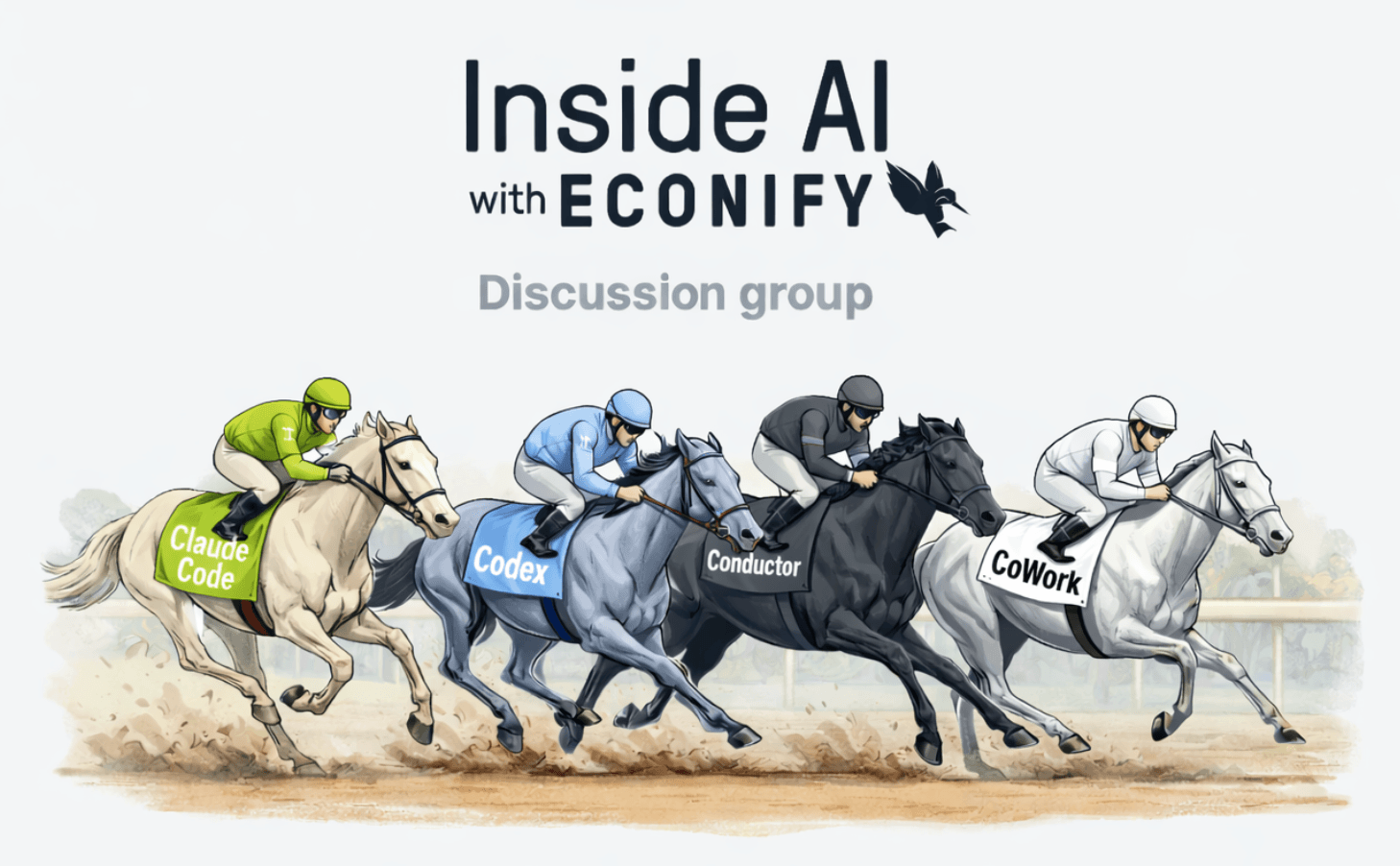
The pace of AI-powered development isn’t just fast; it’s chaotic, competitive, and constantly evolving. In the latest Inside AI with Econify discussion group, Econify brought together practitioners, builders, and AI enthusiasts for a candid, experience-driven conversation about what’s actually working in real-world development workflows. The session explored emerging tools like Claude Code, Codex, Conductor, and CoWork, but quickly expanded into a broader question: in the AI “horse race,” will we ever see a clear winner?
Current Reality: There Is No Single “Best” Tool
One of the clearest takeaways from the discussion was that there is no single tool that currently dominates across all use cases. Instead, teams are mixing tools depending on the task, switching models based on their strengths (whether that’s reasoning ability, speed, or cost) and continuously experimenting as capabilities evolve. What works best today may not be the best choice next month. Rather than a winner-takes-all outcome, the group leaned toward a multi-model, multi-tool future, where flexibility is more valuable than standardization.
What Actually Works in Real-World Workflows
Across the discussion, several consistent patterns emerged from teams actively using AI in development. While AI is dramatically accelerating tasks like code generation, refactoring, documentation, and debugging, it is not replacing developers. Human oversight remains essential, particularly when it comes to validating outputs, making architectural decisions, and ensuring quality and security. AI is best understood as a force multiplier rather than a replacement.
Another key theme was that context is everything. The effectiveness of these tools depends heavily on how well context is structured and maintained. Teams seeing the most success are providing clear inputs, constraints, and examples, and using tools that better retain or integrate project knowledge. Without strong context, outputs quickly degrade into inconsistencies, hallucinations, and rework.
Agents Are High Potential, But Nascent
The conversation also explored the rise of AI agents, which promise multi-step, autonomous workflows. While there is strong interest in this area, the consensus was that agents are still early and not yet reliable enough for critical workflows. They remain fragile when handling complex tasks, struggle with maintaining long-term context, and lack consistent evaluation mechanisms. That said, many participants see agents as a near-future breakthrough, particularly as orchestration tools improve.
Evaluation Is Becoming a Core Discipline
As teams adopt multiple models and tools, evaluation is rapidly becoming a core discipline. The question is shifting from “which model is best?” to “which model is best for this specific task?” Teams are increasingly weighing cost, quality, and consistency, and moving toward more data-driven approaches to AI adoption. This shift reflects a broader maturation in how organizations think about integrating AI into development workflows.
The Trade-Off: Speed vs. Cost vs. Quality
This naturally leads to the common trade-off triangle between speed, cost, and quality. Every tool sits somewhere along this spectrum: faster but less accurate, more powerful but more expensive, or cheaper but less reliable. The most effective teams are dynamically routing tasks to different models based on the use case and avoiding over-reliance on any single provider. In this context, the idea of a clear “winner” becomes less relevant.
So… Will There Ever Be a Winner?
Ultimately, Econify’s perspective is that we are unlikely to see a single dominant tool emerge. Instead, the future will likely consist of specialized leaders in different tasks, rapid iteration cycles that constantly reshape the landscape, and ecosystems of tools working together rather than one platform taking over. In other words, the “horse race” may never truly end, it simply continues to accelerate.
If there was one unifying conclusion from the session, it’s that the advantage will go to the most adaptable teams. Success in AI-powered development won’t come from choosing the “right” tool once, but from continuously evaluating, integrating, and evolving alongside a rapidly changing ecosystem.
Next on Inside AI
Previously...
Inside AI has hosted a range of speakers and industry experts sharing how companies are putting AI to work:
- Pete Pachal - The Media Copilot on "AI and the New Shape of Content: From Discovery to Creation"
- Jason Smith - Publicis Group on "Code Red: AI's Acceleration & Our Response"
- Joe Meersman - Gyroscope AI on "AI in Media: The Future of News and Fake News in an AI Age"
- Lauren Wallett - Creatrix SaaS Inc on "The Challenges of AI and Design Thinking"
- Peter Yared - Layer3.news on "Preparing Companies for Strategic AI Implementation"
If you're interested in revisiting highlights from past discussions—back when we called this our AI Working Group—you'll find a curated selection of summaries below.