The Loop
The Loop: OpenAI Launches GPT-5.6 Family With Stronger Performance at Lower Cost
BY Econify
•Fri, Jul 24, 2026
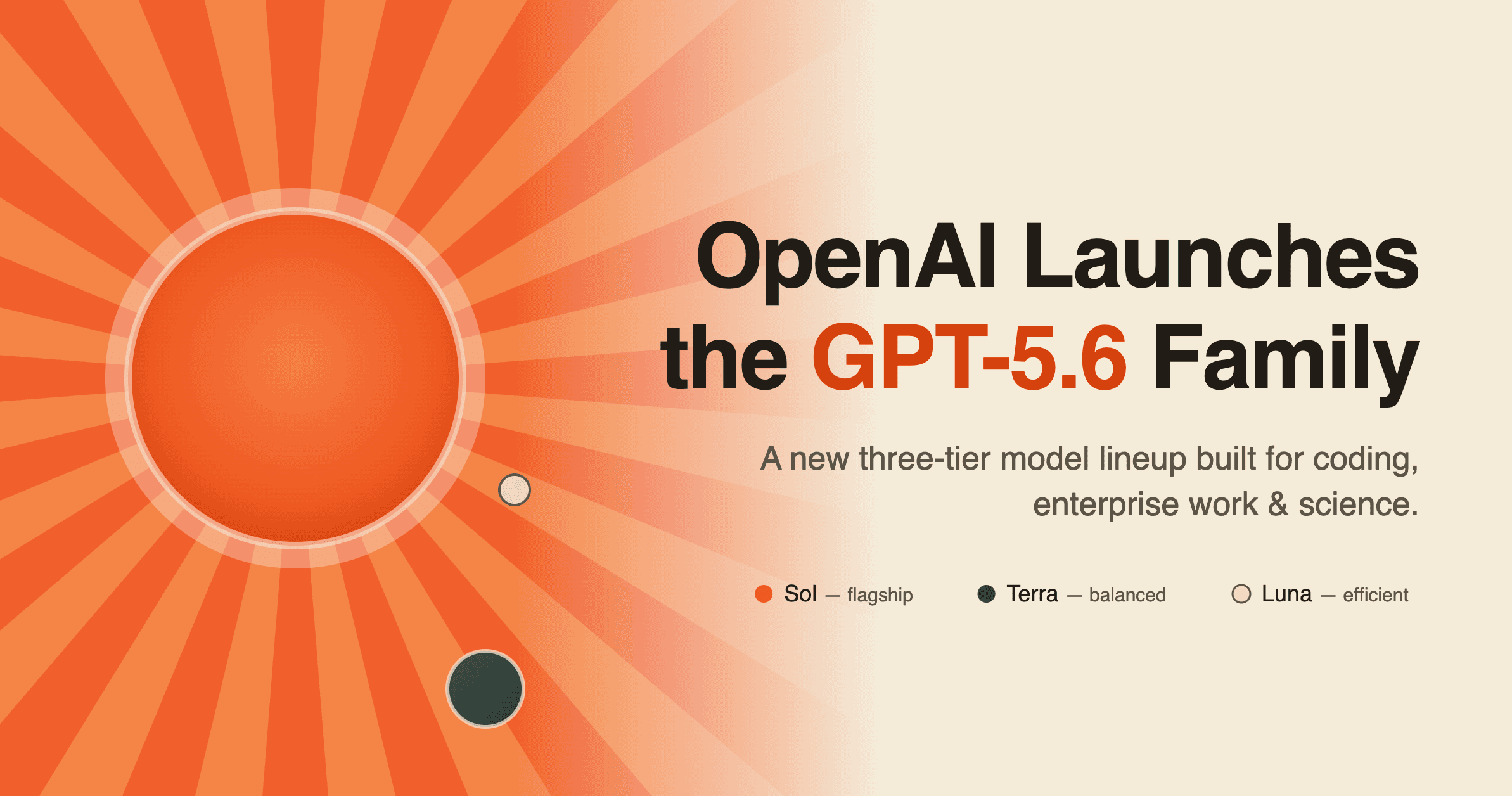
OpenAI has released GPT-5.6 for general availability, and the headline isn't the capability jump, it's the price of it. The new three-tier family (Sol, Terra, Luna) beats predecessor models on long-horizon agentic work while using significantly fewer tokens to get there. On long-horizon agentic workflows, Sol outperforms Claude Fable 5 by over 13 points at roughly one-quarter the estimated cost. Luna and Terra tell a similar story further down the price curve.
A few things stand out beyond the benchmark numbers:
- Multi-agent by default. The new "ultra" mode coordinates four agents in parallel, improving both result quality and time-to-completion on demanding tasks. Developers can build equivalent experiences through the Responses API today.
- Programmatic Tool Calling. GPT-5.6 can now write and execute lightweight programs in-memory to coordinate tools and filter intermediate results, reducing the number of model round trips required for complex agentic workflows.
- Cybersecurity capabilities are accelerating fast. Sol nearly doubles GPT-5.5's peak exploit generation pass rate on ExploitGym. OpenAI is gating the most sensitive capabilities behind a verified Trusted Access program, but the dual-use implications here are real and worth watching.
Econify's Take: The efficiency story is what engineering leaders should focus on. Better performance per dollar means teams can run more capable models on existing budgets, or meaningfully cut AI infrastructure costs without downgrading results. The multi-agent and programmatic tool calling additions point at something worth watching too: agentic architecture shifting away from single-model orchestration and toward coordinated, parallelized workstreams the model helps manage itself.
Anthropic Restores Fable 5 Access After US Export Controls Lifted
After three postponed deadlines and months of uncertainty following the US government's brief export control suspension, Anthropic has settled on how Fable 5 will be distributed. As of July 20, the model is included without surcharge only on Max and Team Premium plans. Pro and Team Standard subscribers lose included access and move to a credit-based model, after which standard API pricing applies. Fable 5 carries the highest token cost in Anthropic's lineup.
The repeated extensions are worth noting. Anthropic cited unpredictable demand, but the timing aligns closely with OpenAI's GPT-5.6 release, which benchmarks comparably to Fable 5 at a lower price point. Whether competitive pressure played a role or not, the result is the same: Anthropic's most capable generally available model is now effectively gated behind its most expensive subscription tiers.
Econify's Take: For engineering teams evaluating AI spend, this changes the calculus. Fable 5 was briefly the most capable model available at consumer subscription prices. It no longer is. Teams that built workflows around it should plan for meaningfully higher costs going forward. The broader pattern here is one the industry is still working out: how to price frontier capability without pushing developers toward cheaper, comparably performing alternatives.
What Databricks Learned Benchmarking Coding Agents on Its Own Codebase
Databricks ran coding agents against actual pull requests from its own multi-million line codebase and published the results. The methodology matters as much as the findings: rather than relying on public benchmarks like SWE-Bench, which leak into training data over time and may not reflect a given team's stack, Databricks built tasks from real merged PRs, graded by the tests their engineers wrote. Any team with a backlog of merged PRs is sitting on the same raw material.
Three findings stand out:
- Token price is a poor proxy for actual cost. Sonnet 5 costs roughly 1.7x less per token than Opus 4.8, but on Databricks' tasks it ended up more expensive per task due to lower reasoning efficiency, consuming nearly twice the tokens to reach a lower completion rate.
- The harness matters as much as the model. Running the same model through different harnesses produced cost differences of more than 2x with no meaningful quality difference. Context management, not model intelligence, was the primary driver.
- Open-weight models are ready for production codebases. GLM 5.2 landed in the top capability tier, statistically tied with Opus 4.8 on quality at a lower cost per task. Databricks is now deploying it as a daily driver for engineering work.
Econify's Take: The broader lesson here is one we've seen play out with infrastructure decisions for years: vendor benchmarks are a starting point, not a decision framework. The teams getting the most out of coding agents right now are the ones measuring against their own work. As the model landscape gets more crowded, with GPT-5.6, Fable 5's pricing changes, and Kimi K3 all arriving in quick succession, the ability to evaluate models on your own codebase becomes a genuine competitive advantage.
Moonshot AI Releases Kimi K3, the Largest Open-Weight Model Ever
Beijing-based Moonshot AI has released Kimi K3, a 2.8 trillion parameter open-weight model that benchmarks place alongside Claude Fable 5 and GPT-5.6 at the top of the leaderboard, with full weights dropping publicly on July 27. On GDPval-AA v2 it placed third overall behind only Fable 5 and GPT-5.6 Sol, and it topped both on BrowseComp, at pricing that sits closer to mid-tier than frontier.
What makes this more than a benchmark story is what the open-weight release means structurally. Enterprises that want to fine-tune, self-host, or build proprietary systems on a frontier-class base model now have an option that does not require an API contract with OpenAI or Anthropic. The infrastructure cost of running 2.8 trillion parameters is real, but Moonshot's Mooncake serving architecture was specifically designed to make inference at this scale more practical.
The agentic capability demonstrations are also worth noting. K3 autonomously completed a full chip design pipeline over 48 hours and reproduced a complex astrophysics calculation in roughly two hours, a task that typically takes a senior researcher one to two weeks. These are proof-of-concepts, not production results, but they point in the same direction the rest of the frontier is heading.
Econify's Take: The gap between open-weight and proprietary frontier models is closing faster than most build-vs-buy conversations have caught up with. For engineering leaders, that’s worth revisiting now, particularly for teams with the infrastructure to self-host and the desire to avoid vendor lock-in. Taken together with GPT-5.6's efficiency gains and Fable 5's pricing changes, this week's model releases signal that frontier AI is getting both more capable and more contested at the same time.
TypeScript 7 Ships With a Native Go Port and Up to 10x Faster Builds
TypeScript 7 is out, and the headline change is a full rewrite of the compiler in Go. The result is build times that are 8x to 12x faster on real-world codebases, with lower memory usage across the board. On the VS Code codebase, a full build drops from 125 seconds to under 11. Editor load time for the same project goes from 17.5 seconds to under 1.3. These numbers come from production codebases at Slack, Canva, Vanta, and others who participated in the preview, not synthetic benchmarks.
The performance gains extend beyond the CLI. The new language server is built on LSP, supports multithreading, and has reduced language server crashes by over 60% compared to TypeScript 6. Slack reported that TypeScript 7 eliminated 40% of their merge queue time and brought CI type-checking from 7.5 minutes to 1.25. Teams that had effectively given up on local type-checking due to load times are reporting it is usable again.
A few caveats worth noting for teams planning adoption:
- No programmatic API yet. TypeScript 7.1 is expected to ship one, but until then, tooling that embeds TypeScript, including Vue, Svelte, Astro, and Angular templates, cannot yet leverage TypeScript 7. Those teams should stay on 6.0 for editor support.
- Breaking changes from 6.0 apply. Strict mode is on by default, several legacy module resolution options are removed, and some JS support behaviors have changed.
Econify's Take: A 10x compiler speedup is the kind of infrastructure improvement that compounds across an entire engineering organization. Faster feedback loops in the editor, shorter CI runs, and more usable local type-checking all reduce the friction that slows teams down at scale. For organizations running large TypeScript monorepos, the upgrade case is straightforward. The main reason to wait is the missing programmatic API, which matters primarily if your toolchain depends on framework-level TypeScript embedding.
