The Loop
The Loop: Anthropic’s Fable Preview Briefly Reveals Next-Gen Mythos Capabilities Before Shutdown
BY Econify
•Wed, Jun 24, 2026
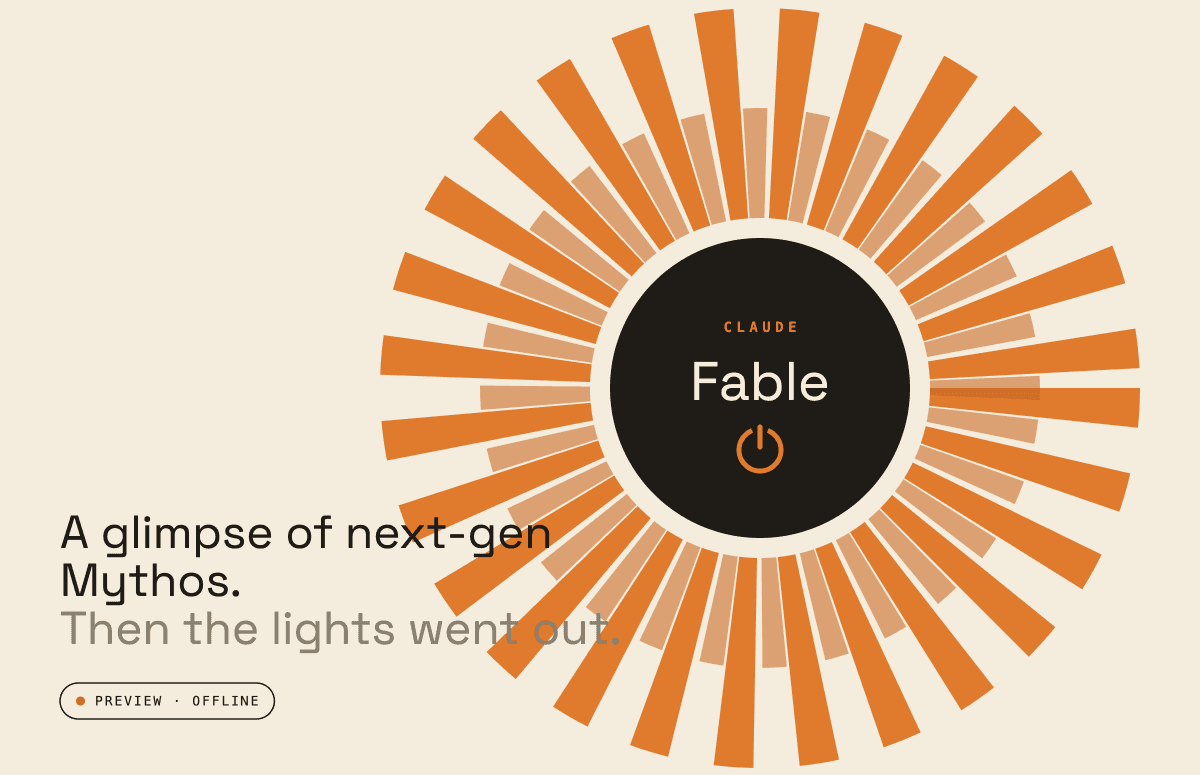
Anthropic’s Fable release was positioned as an early preview of capabilities coming in its more advanced Mythos models. The goal was to provide limited external access while validating behavior before a wider rollout. Early users and partners reported a noticeable improvement in performance, especially on multi-step reasoning tasks and workflows that involved tool use or longer sequences of actions.
What stood out was not just raw output quality, but how well the system handled problems that require breaking work into steps and using intermediate results. Even in a constrained preview setting, it behaved more like a system that can carry a task through multiple stages rather than producing a single response.
That rollout did not last long. Concerns raised during internal evaluations and red-team testing, combined with external scrutiny, led to a rapid restriction of access. The result was a rollback of both Fable and Mythos availability, effectively ending the preview phase shortly after it began.
The notable part of this sequence is the speed of the reaction. A short preview period was enough to trigger internal security reassessment and external regulatory involvement, collapsing what would normally be a gradual release cycle into a rapid rollback.
Econify's Take: What stands out here is the gap between the capability shown in preview and how quickly it triggered concern and intervention. The reaction suggests these systems are being evaluated based on what they can actually do in real workflows, not just benchmark results.
Even a short exposure window was enough to surface capabilities that go beyond previous generations, particularly in how they handle multi-step, tool-based tasks. That combination of capability and uncertainty is what is now shaping both excitement and caution around frontier models.
“Loops” Emerge as a New Focus in AI Engineering Discussions
At Meta’s @Scale conference, Claude Code creator Boris Cherny framed “loops” as the next major shift in how AI systems are built. His argument was that the industry has already moved from hand-written code to agent-generated code, and is now moving again toward systems where agents continuously prompt and coordinate other agents to complete work.
In this model, AI systems are no longer invoked for discrete tasks. Instead, they run continuously in the background, cycling through planning, execution, and review steps. Cherny described internal setups where one agent focuses on architectural improvements while another looks for duplicated abstractions, both continuously generating pull requests as the codebase evolves.
The idea is already generating debate. On one hand, it extends the trajectory of agentic systems into something more autonomous and persistent. On the other hand, it raises questions about whether this is a real architectural shift or a reframing of existing patterns like retries, schedulers, and background workers under a new name.
There is also a practical constraint that quickly emerges in the discussion: cost. These systems rely on repeated model calls across long-running loops, which can drive token usage significantly higher than traditional prompt-based workflows. When loops are left running continuously, spend becomes a primary design consideration rather than an afterthought.
Econify's Take: Loops are best understood as an execution model, not a feature. The shift is less about agents being more capable and more about systems being designed to run them repeatedly without human re-invocation.
The open question is where this system is actually worth it. Without careful control of stopping conditions and spend, loop-based systems can degrade into expensive background compute with unclear return. If you made it this far, don’t worry, you’re already in The Loop.
Cloudflare Brings VoidZero and Core Vite Tooling Under Its Developer Platform
Cloudflare is bringing VoidZero into its organization, the team behind Vite, Vitest, Rolldown, and Oxc. The announcement positions this less as a traditional acquisition and more as an attempt to align the Vite ecosystem with Cloudflare’s developer platform, particularly as AI-assisted development becomes a primary driver of how applications are built and shipped.
The key theme across the announcement is not just tooling performance, but where that tooling is now being used. Vite is increasingly described as part of the execution surface for AI-generated code. Agents scaffold projects, run dev servers, execute tests, and iterate through feedback loops at a pace that pushes build tooling to become part of the runtime workflow rather than just a compilation step.
Cloudflare’s framing makes this explicit: as more code is produced by agents, the surrounding system has to support fast, repeatable loops for build, test, and deployment. That includes integrating directly with runtimes like Workers and exposing consistent developer workflows that can be driven both by humans and automated agents.
At the same time, the move further concentrates influence over a foundational part of the JavaScript ecosystem. Vite has become a default entry point for modern frontend and full-stack development, and now sits closer to Cloudflare’s deployment and execution layer. While the intent is framed as openness and portability, the practical outcome is a tighter coupling between toolchain and platform.
Econify’s take: This is a strategic consolidation of influence over a key layer of the JavaScript ecosystem. Vite and its surrounding tooling are no longer just open-source utilities, they are becoming part of platform-level infrastructure.
For engineering teams, the implication is less about performance or features and more about dependency shape. When build tooling sits closer to a platform provider, decisions about workflow, integration, and optimization increasingly flow from platform architecture rather than isolated tool choice.
Chrome's Declarative Partial Updates Could Reshape How We Build Server-Rendered Apps
Chrome 148 quietly shipped something worth paying attention to. Declarative Partial Updates (DPU) introduces two new primitives to the web platform: out-of-order HTML streaming via <template for> placeholders, and a clean, consistent set of JavaScript insertion and streaming APIs to replace the fragmented mess of innerHTML, insertAdjacentHTML, and friends. Together, they let servers stream HTML into specific page slots as content becomes ready, with no JavaScript framework required to orchestrate the swap.
This is part of a broader pattern we've been watching. For years, patterns like island architecture, streaming rendering, and persistent app shells were framework problems. The web platform is now building them natively.
The implications cut across a lot of the stack:
- Island architecture goes native. What Astro popularized as a framework pattern for independently hydrating page regions becomes a browser primitive.
- SPAs can finally stream. Dynamically loaded content in single-page apps has always had to buffer before rendering. The new streaming JS APIs (streamHTML, streamAppendHTML, etc.) change that.
- Server-first stacks get stronger. Rails, Django, Go, any backend that emits HTML can now deliver genuinely dynamic, out-of-order content without a JS framework in the middle.
Cross-browser alignment is stronger than most experimental features at this stage. Firefox has given the proposal a positive standards position and WebKit has signaled support. All three engines leaning the same direction this early is uncommon. Polyfills are available on npm today, though they buffer rather than truly stream, so the real performance story won't land until native support broadens.
Econify's Take: DPU isn't a framework replacement, but it does erode some of the core justifications for reaching for one. Teams running server-rendered stacks who've been paying a framework tax just to get streaming and component-based updates have the most to gain here. We'd watch this alongside HTMX adoption trends and the still-in-design route matching spec. If that piece lands with the same cross-browser alignment, the gap between a lightweight server-rendered app and a full framework stack gets a lot narrower.
